
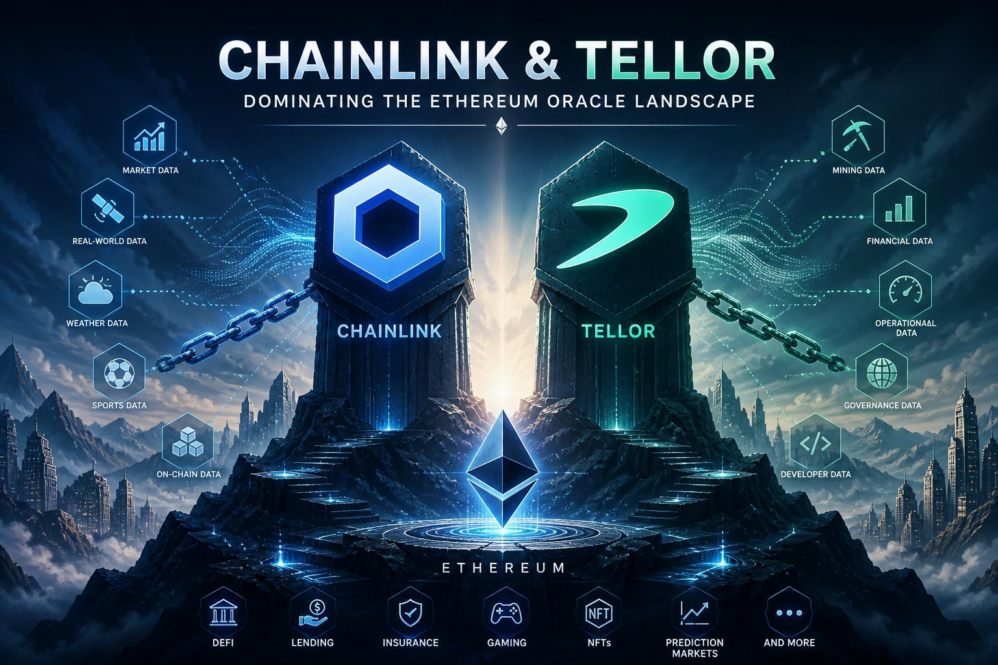
The Rise of Decentralized Oracles in Smart Contract Ecosystems
Decentralized oracles have become a cornerstone in the smart contract ecosystem, bridging the gap between blockchain technology and the external world. These oracles act as the eyes and ears of smart contracts, providing the necessary data and off-chain interactions needed for them to function beyond simple, on-chain logic. Chainlink and Tellor, two of the most prominent oracle networks, have emerged as dominant players in this space, setting the standard for transparency and reliability. Both platforms aim to provide users with access to real-world data in a secure and decentralized manner, essential for the growth of DeFi and beyond. Their rise signals a shift towards more sophisticated, yet accessible, smart contract applications.Chainlink, the market leader, provides a framework where users can easily connect their smart contracts with off-chain data and systems. This network has garnered important attention for its wide range of services, extending beyond conventional price feeds to more complex and diverse data types. The platform’s robustness and security are bolstered by its decentralized architecture, ensuring that no single point of failure can disrupt its operation. As smart contracts evolve and demand broader and more specific data sources, chainlink’s ability to meet these needs will onyl strengthen its position. Integrating Chainlink into your blockchain project can offer a range of benefits, from improved transparency to reduced operational risks.
Tellor, on the other hand, differentiates itself with its focus on data integrity and consensus mechanisms. By requiring miners to submit valid data rather than hash power alone, it aims to prevent Sybil attacks and ensure the reliability of the data provided. This makes Tellor an attractive solution for applications where data trustworthiness is paramount, such as real estate or legal document verification within a smart contract. Tellor’s approach highlights a unique challenge faced by oracle networks: balancing efficiency with security and trust. The platform uses an innovative mining algorithm that requires miners to provide data rather than compete for block rewards, setting it apart from other oracle solutions on the market.
Both Chainlink and Tellor have fostered vibrant communities that continually push the boundaries of what on-chain ecosystems can achieve. Developers on these platforms are not just users but active contributors, participating in governance and proposing new features that enhance the capabilities of both systems. This community-driven development model has been key to their rapid evolution and widespread adoption. While both platforms offer distinct value propositions, they share a common goal: to make blockchain technology more accessible and reliable for a wider range of applications. This shared vision is driving innovation and solidifying their roles as leaders in the decentralized oracle space.
How Chainlink and Tellor are Revolutionizing Data Feeds on ethereum
Chainlink and Tellor are two powerhouse solutions in the Ethereum ecosystem, each with their own unique approaches to ensuring the reliability and decentralization of data feeds. Both platforms aim to bridge the gap between the blockchain world and traditional off-chain data sources, but they do so with different philosophies and methods. Chainlink prides itself on being a middleware layer that connects smart contracts with secure off-chain data,while Tellor takes a more consensus-driven approach by using a blockchain-specific data mining mechanism. This dynamic duo is reshaping how developers can access critical data and integrate it into blockchain applications, ensuring the integrity and security of smart contracts on the Ethereum network.
The core of Chainlink’s innovation lies in its oracle services, which act as custodians of off-chain data, ensuring that it is indeed accurate, reliableand tamper-proof before being fed into smart contracts. this process involves aggregating data from multiple sources to mitigate single points of failure. In contrast, Tellor operates on a decentralized data mining model, where miners are incentivized to provide data by mining blocks across a dedicated blockchain. This approach not only secures data but also introduces a new layer of competition to maintain the highest standards of accuracy and reliability. While Chainlink focuses on quality over quantity, Tellor offers a broader array of data through its decentralized mining network.
To better understand how these platforms operate, consider the following scenarios: a developer integrating Chainlink oracles might choose from a variety of data feeds, including financial market data, web API callsor even machine-generated data from IoT devices. conversely, a developer working with Tellor would benefit from its multi-chain and multi-language support, allowing for greater flexibility in accessing diverse data sets. Despite their differences, both platforms enable smart contracts to trust data inputs from outside the Ethereum network, which is crucial for applications requiring real-world data interaction.
Ultimately,the choice between chainlink and Tellor depends on the specific needs of a project. For tasks that require a high level of data integrity and security, with a robust decentralized network behind it, Chainlink might be the better choice. On the other hand,projects that demand high scalability and a diverse range of data sources may prefer Tellor’s mining-based model. Both platforms stand to benefit the Ethereum ecosystem by providing reliable, tamper-proof data feeds, thereby enabling a new era of innovation for decentralized applications.
Comparing Chainlink and Tellor: Features, Use Casesand Performance
At the forefront of the Ethereum oracle space, Chainlink and Tellor stand out as essential players, each offering distinct features and capabilities. Both networks are designed to bring reliable off-chain data to on-chain smart contracts, enabling real-world applications to interact with blockchain technology. Yet, their approaches and use cases diverge, making them suitable for different types of projects. As a notable example, Chainlink is widely known for providing various services beyond just data oracles, including verifiable randomness and cross-chain dialog capabilities. This versatility makes it a go-to network for developers looking to integrate a wide array of functionalities into their decentralized applications.
In contrast, Tellor focuses on offering security and reliability through its innovative consensus mechanism and robust dispute resolution system. One of the key distinctions is that Tellor uses a proof-of-stake mining protocol, which contrasts with Chainlink’s more diverse approach to data sourcing. Tellor’s design ensures that data is not only accurate but also resistant to manipulation, thanks to its community-driven dispute system. This system allows anyone to challenge and verify the accuracy of data submissions, thereby enhancing the reliability of the oracle network.
When comparing performance, it’s important to note that both networks have their strengths. Chainlink excels in delivering data with high frequency and a wide range of options, making it ideal for applications that require real-time data feeds. This includes financial markets and gaming applications that demand instantaneous data for accurate outcomes. On the other hand, Tellor is optimized for providing data that needs to be highly secure and tamper-proof, such as for legal contracts or asset pricing validation. Both networks have established themselves as reliable sources, but their use cases and performance benchmarks cater to different needs within the blockchain ecosystem.
To better illustrate the differences, here’s a swift comparison table that highlights some key features and use cases for both Chainlink and tellor:
| Chainlink | Tellor | |
| Key Features | Data oracles, verifiable randomness, cross-chain communication. | proof-of-stake mining, dispute resolution mechanism, security-first data. |
| Use Cases | Real-time financial data, gaming applications, automation, randomness for smart contracts. | Legal contracts, tamper-proof asset pricing, financial audits. |
Understanding the nuances between Chainlink and Tellor equips developers with the knowledge they need to choose the right tool for the job,ensuring that their applications benefit from the strengths of each network.
Strategic Considerations for Developers choosing Between Chainlink and Tellor
When deciding between Chainlink and Tellor, developers should weigh the needs of their decentralized applications (dApps) against the offerings provided by each platform. Both Chainlink and Tellor are well-established in the Ethereum ecosystem, but they cater to different needs and have distinct approaches that may suit certain projects better than others.One of the fundamental considerations is the type of data integration required. Chainlink is renowned for its versatility and extensive range of data sources, making it a go-to choice for projects that need multiple feeds, complex data sets, and API integrations. On the other hand, Tellor shines in scenarios where proof-of-work (PoW) data validation is crucial, providing an additional layer of security against data tampering. While this extra security is a significant benefit, it might add complexity and overhead to the integration process for straightforward use cases.
The cost and efficiency implications are another critical factor. Chainlink’s decentralized network allows for scalable and flexible oracle services, with prices frequently enough tied to the complexity of the requested data and the reliability of the sources. Conversely, tellor’s PoW mechanism ensures data integrity but also introduces a higher computational cost, primarily due to the validation process. This makes Tellor more resource-intensive and less scalable for high-frequency data requests or large-scale projects. For developers, understanding these trade-offs will be essential in selecting the right platform.
Lastly, the ecosystem and community support can heavily influence the decision-making process. Chainlink has a wider user base and a broader range of partners,fostering a more extensive development and support network.This extensive community benefits developers by offering a wealth of resources, including documentation, libraries, and tools to expedite the integration process. Tellor, while still robust and active, is smaller, giving it a more niche focus and perhaps a tighter-knit community. A developer looking for a community with deep expertise in data integrity and pow mechanisms might find Tellor’s community notably enriching.
| Platform | Key feature | Cost | Ecosystem |
|---|---|---|---|
| Chainlink | Wide range of data sources,API integrations | Flexible,variable pricing | Extensive |
| Tellor | Data integrity,PoW validation | Higher due to computational costs | Niche focus |
Best Practices for Integrating Chainlink and Tellor in DeFi Applications
Integrating Chainlink and Tellor into DeFi applications requires a deep understanding of both platforms’ capabilities and limitations. Developers must ensure that their smart contracts are robust and that the data they rely on is of the highest quality. By adopting best practices, one can create applications that are both reliable and efficient. For instance, using Chainlink’s advanced data protocols, you can fetch off-chain data directly into your smart contract, enhancing its functionality without overly complicating its execution.
To illustrate, a common scenario involves fetching prices from external price oracles to mitigate the price manipulation risk inherent in DeFi trades. Chainlink offers several data feed options that cater to the needs of various types of tokens, from major cryptocurrencies to smaller asset classes. These feeds come with reliability guarantees and security features built into their design, ensuring peace of mind for developers. Such as, Chainlink’s decentralized oracle network reduces the risk of single points of failure by using a large network of node operators to provide data redundancy.Tellor, conversely, stands out with its proof-of-stake mechanism and an innovative data mining protocol which encourages a healthier, more decentralized approach to data retrieval. developers use Tellor’s oracles not just for price feeds but also for any kind of data that needs to be securely and reliably stored on the blockchain. A key advantage of Tellor is its community-driven governance, which allows for dynamic changes to how the network operates. Integrating both Chainlink and Tellor can create a more robust application that taps into diverse data sources.
To get the most out of using both platforms, developers should focus on maintaining strong security and governance practices. This includes staying informed about updates and changes to the networks and actively participating in community forums to learn from peers. One effective way to manage dependencies is to periodically review and update your smart contracts to incorporate improvements from both Chainlink and Tellor. Below is a simple guideline that outlines tasks for integrating both platforms effectively:
| Task | Description |
|---|---|
| Select Oracle feeds | Choose reliable and secure data sources from both Chainlink and Tellor. |
| Integrate Security features | embed security protocols like KYC and AML checks. |
| Monitor Network Status | Stay alert to upgrades and changes in how the platforms operate. |


