
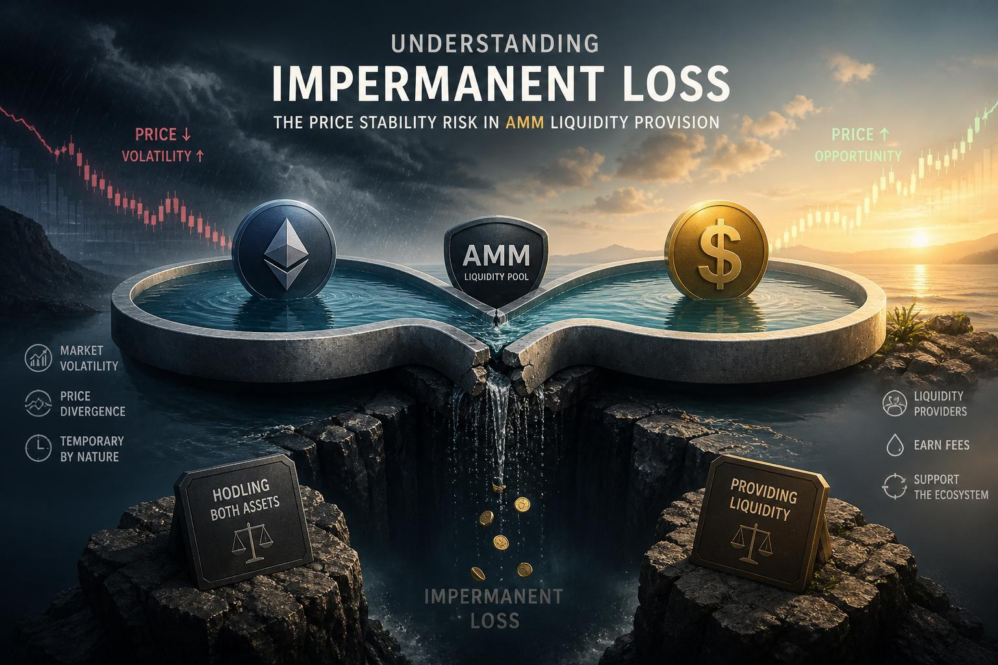
Impermanent Loss Defined and Explained
Impermanent loss, a key concept in the world of automated market makers (AMMs), refers to the reduction in value experienced by liquidity providers due to volatile price movements in an AMM pool. This unique financial risk can be perplexing, especially for those new to decentralized finance (DeFi). Unlike other financial risks that involve outright losses or gains, impermanent loss is a measure of the difference between holding tokens and providing liquidity for those tokens. According to The Free Dictionary, impermanent is defined as “not lasting or durable; not permanent,” reflecting the nature of this loss, which can fluctuate and perhaps reverse over time as the market stabilizes.
The essence of impermanent loss lies in the fact that liquidity providers exchange tokens for an AMM liquidity token, essentially becoming part of a shared pot that helps determine token prices through supply and demand dynamics. When the price of a pair in the pool fluctuates,the value of a liquidity token deviates from the value of holding the same tokens outside of the pool. users of AMMs,thus,must navigate this complex interplay between providing liquidity and the inherent risk of price volatility. To better understand this concept, consider a basic table illustrating how impermanent loss can manifest.
| token A | Token B | Total value |
| 100 | 100 | 200 |
| 130 | 70 | 200 |
In this table, if a liquidity provider holds 100 units of Token A and 100 units of Token Band then the value of Token A rises to 130 units while Token B drops to 70 units, the provider would see a loss if they had not locked these tokens in an AMM. However, impermanent loss captures the nuance that the provider’s tokens, when locked in the AMM pool, are worth more than the tokens outside the pool under some conditions, but less in others.
Recognizing impermanent loss as merely a temporary economic phenomenon is crucial for liquidity providers, who might be incentivized to monitor and reassess their token allocations based on market conditions. This risk is closely tied to the dynamic nature of AMMs, where the provision of liquidity is a trade-off between gaining trading fees and potential gains from market trends and experiencing impermanent loss. Ultimately, understanding how imbalances within a liquidity pool lead to impermanent loss is essential for any investor or trader looking to fully grasp the mechanics of AMMs and the broader landscape of DeFi applications.
The Mechanics Behind Impermanent Loss in Automated Market Makers
Impermanent loss in Automated market Makers (AMMs) is a critical concept for those diving into decentralized finance (DeFi) pools. This phenomenon occurs when liquidity providers (LPs) experience a decrease in their assets as compared to holding them separately when the asset price fluctuates. It’s not a reflection of a market downturn or poor investment choice but a natural result of the AMM system. The core principle behind AMMs, such as Uniswap, is to maintain a balance between two tokens according to a predefined ratio, typically the constant product formula where x * y = k (where x and y are the amounts of the two tokens and k is a constant).
the loss becomes impermanent because, unlike a customary exchange where you could lock in gains or losses directly by trading, in an AMM, your liquidity is locked in and the system adjusts balances to maintain pricing equilibrium. Thus, any trades that alter the price can make your liquidity position less than it was at the time of investment. This isn’t always a loss in traditional terms, as the value can rebound if prices revert. Though, it signifies a momentary dip in portfolio value due to an unexpected price swing. When tokens are withdrawn, the value is recalculated, often revealing a recovery, hence the term ‘impermanent.’
The mechanics of impermanent loss involve the fluctuation of token prices versus the fixed ratio within the liquidity pool. Let’s look at a simple example: suppose you deposit an equal value of tokens A and B into a liquidity pool at a 1:1 ratio. If the price of token A increases relative to token B, the pool will buy more of token B.This adjustment might cause a temporary imbalance in your portfolio if you hadn’t directly traded beforehand. The dynamics of liquidity provision in AMMs are akin to floating in a fast-moving river; you’re always adjusting to the current, which can lead to temporary ‘sinkings’ even as the river continues to flow. This is why it’s crucial for liquidity providers to understand and manage the risks involved.
When considering joining an AMM as a liquidity provider, understanding the potential for impermanent loss is essential. You might be contributing to the stability of the market while taking on personal financial risk. A well-informed strategy involves knowing the dynamics of your liquidity pool, which is directly tied to the price stability of the assets you’re providing liquidity for. This isn’t a deterrent but a necessary caution to ensure realistic expectations and risk management. To better illustrate, here’s a simplified table showing the impact of price fluctuation on a liquidity pool:
| Initial Token Value | Price Change (%) | Impermanent Loss (%) |
|---|---|---|
| $100 | +10% | -1.5% |
| $100 | -10% | 0 (no loss) |
This table demonstrates that even moderate price changes can lead to minor losses,reminding us that impermanent loss is a nuanced aspect of liquidity provision in AMMs. Understanding these mechanics helps in better navigation of the DeFi ecosystem.
Risk Factors and common Scenarios where Impermanent Loss Occurs
Impermanent loss, a critical risk factor in the realm of automated market makers (AMMs), primarily manifests when there’s a significant imbalance in the exchange rates of the assets provided by liquidity pools. This can happen during volatile market conditions where one asset’s price skyrockets while the other plummets, leaving liquidity providers (LPs) with a smaller share of the pool compared to what they initially inputted. The core principle is straightforward: the risk grows as the spread between the paired tokens widens. In such scenarios, LPs might be left holding a larger share of the less valuable asset and a smaller share of the more valuable one, causing a drop in their total investment value.
to provide a clearer picture, consider three primary conditions under which impermanent loss commonly arises. These scenarios hinge on shifts in market dynamics that challenge the stability typically enjoyed by LPs. First,when there’s a sudden surge in demand for one token over the other,often seen during speculative runs or news-based price spikes. Second, when market volatility introduces unpredictable trends, making it hard for LPs to predict how token values will fluctuate over short periods. Lastly,when arbitrage opportunities exist,causing sharp price corrections almost instantaneously. Each of these situations tests the resilience of liquidity providers, making them acutely aware of the impermanent losses that can occur.
To illustrate the complexity and variability of these risks, a glance at past examples reveals patterns that are instructive for LPs. For instance, during the 2020 DeFi boom, several popular token pairs experienced wide price swings, leading to significant losses for some LPs who were caught off guard. A key takeaway from such events is that LPs must be vigilant and adaptable, ready to adjust their strategies in response to market signals. This might include hedging positions, diversifying token pairsor even temporarily exiting liquidity provision to avoid exposure to volatile conditions.
Understanding the dynamics of impermanent loss also involves recognizing the nuances that differ across various AMM platforms. While the core mechanism remains consistent, the implementation details, such as fee structures, liquidity mining incentivesand the underlying smart contracts, can affect the extent of losses LPs face. Such as, some platforms may offer more favorable conditions or advanced features that mitigate risks for liquidity providers. It’s essential for investors to deeply understand these factors and their implications, ensuring they can make informed decisions that align with their risk tolerance.
Strategies and Tactics to Mitigate Impermanent Loss for LPs
As a liquidity provider (LP) in automated market making (AMM) platforms,the concept of impermanent loss (IL) is something you cannot ignore. This phenomenon is a reality of the dynamic nature of price movements and can eat into your yield in a matter of days or hours. However, understanding and implementing strategies to manage IL can considerably boost your returns and reduce risks. One such strategy is to adjust your allocation ratio according to market conditions. A common scenario involves a token pair where one token appreciates much faster than the other, leading to a shift in value distribution. By adjusting the ratio of tokens in your liquidity pool, you can better align with the market’s trend, mitigating the impact of IL.
Another tactic involves choosing the right trading pairs. certain token pairs are more volatile than others due to their unique economic characteristics or market sentiments. High volatility leads to higher chances of IL, as large price fluctuations can quickly affect the pool’s balance. to mitigate this, consider providing liquidity to pairs that have a history of relative price stability or are closely correlated to each other. As an example, providing liquidity to a stablecoin pair often presents a lower risk profile compared to high-volatility assets. Understanding these dynamics allows you to make informed decisions and protect your capital.
Timing is also key in managing IL. Avoiding periods of high volatility can be beneficial. For example,during initial coin offerings (ICOs) or major market events,prices can become extremely unpredictable. These periods can lead to ample IL before the market stabilizes. Monitoring market trends and entering or exiting liquidity pools strategically can help manage exposure to volatile conditions.Some traders opt for a long-term approach and keep their liquidity locked in for extended periods, while others prefer to be more active and move in and out of pools as market conditions dictate.
| Strategy | Description |
|---|---|
| Token ratio Adjustment | Modifying the ratio of tokens in a liquidity pool to match current market conditions. |
| Choosing Stable Pairs | Selecting token pairs with low historical volatility to minimize IL exposure. |
| Timing Entry/Exit | Actively managing liquidity by entering or exiting during low-volatility periods. |
These strategies require a deep understanding of market dynamics and the ability to make timely decisions. While they cannot completely eliminate the risk of IL,they provide a framework for managing it effectively. By doing your due diligence and staying proactive, you can navigate the complexities of AMM liquidity provision and enhance your returns in the decentralized finance (DeFi) ecosystem.
Best Practices for monitoring and managing Your Liquidity pool Investments
Understanding and managing impermanent loss effectively requires a vigilant approach to monitoring and managing liquidity pool investments in automated market makers (AMMs). Start by establishing clear goals for your liquidity provision, including expected return thresholds and time horizons. To ensure you are making informed decisions, regularly check the price movements of the tokens in your liquidity pools using reliable market analytics tools.Monitor the price spreads and trading volumes closely to anticipate potential volatile periods. This awareness will enable you to take timely action, such as adjusting your asset allocation or rebalancing your positions to minimize losses.
A practical strategy involves setting up automated alerts that notify you of significant price deviations or changes in liquidity levels. Platforms like Uniswap or Curve offer built-in tools to help with thisand third-party applications can also provide more tailored alerts. consider creating a risk assessment framework to quantify the potential impact of impermanent loss on your portfolio. Evaluate the historical performance of your liquidity provision to identify trends or patterns that could indicate future stability or risk. This proactive approach helps in maintaining a balanced portfolio amidst market fluctuations.
Managing liquidity pool investments also means staying informed about the broader market dynamics and understanding the impact of major news events and economic indicators. Regularly reviewing your investment portfolio against these factors can help you make more strategic decisions about your liquidity provision. Engaging with the community and participating in forums can provide valuable insights and early warnings of market shifts. Networking with experienced liquidity providers can also offer practical advice and best practices for mitigating impermanent loss. remember, the financial markets are dynamic, and a flexible strategy is key to navigating through the uncertainties.
to simplify your monitoring process and stay updated on critical metrics, consider using a dashboard that aggregates key data points and visualizes performance. A well-designed dashboard can display historical performance, current liquidity ratiosand potential risks at a glance. Table 1 below illustrates a basic dashboard layout to monitor liquidity pool investments:
| Pools | Current Value | 24h Change | 7d Low | 7d High |
|---|---|---|---|---|
| ETH/USDT | $10,850 | -1.2% | $10,500 | $11,100 |
| DAI/USDC | $1,000,000 | +0.1% | $995,000 | $1,006,000 |
Using these tools and strategies, you can better manage your liquidity pool investments and mitigate the risks associated with impermanent loss.
Recommendations for Optimal Allocation in Volatile Market Conditions
In the realm of automated market makers (AMMs), the concept of impermanent loss poses a significant challenge for liquidity providers. This risk stems from the volatile nature of the market, where the value of assets can shift unpredictably. To mitigate this risk, it’s essential to adopt strategies that enhance the stability and resilience of your portfolio. One effective approach is to diversify across multiple assets and market pairs,which can help spread out the risk and minimize the impact of impermanent loss.
Another strategy is to carefully choose the time frame for providing liquidity. Liquidity provision is often more stable and less prone to impermanent loss during periods of lower volatility and higher liquidity. conversely, during volatile market conditions, the risk of impermanent loss increases significantly. A well-timed entry and exit strategy can therefore be a critical tool for navigating the complexities of AMM liquidity. As an example, you might consider entering multiple liquidity pools at different times, aligning with various market trends and volatility levels.
To further optimize your allocation, it’s crucial to stay informed about market trends and shifts in liquidity demand. Regularly reviewing and adjusting your positions based on current market dynamics can definitely help in maintaining an optimal balance between risk and return.Monitoring tools such as price charts, trading volumesand liquidity indicators provide valuable insights into the most suitable assets and pools for liquidity provision at any given time.
Here’s a simple guide to help you apply these strategies in practice. Consider alternating between high and low volatility periods, and align your liquidity provision with market cycles.This approach not onyl helps in mitigating impermanent loss but also allows for strategic profit-taking during stable market conditions.
| market Condition | Recommended Strategy |
|---|---|
| High Volatility | decrease exposure, focus on stablecoins |
| Low Volatility | Increase exposure, explore new market pairs |
By following these recommendations, you can better navigate the dynamic and ever-changing landscape of AMMs and safeguard your investments from the risks associated with impermanent loss.


