
Understanding the Fundamentals of Yield Farming
yield farming, a central concept in the world of decentralized finance (DeFi), revolves around maximizing returns on invested assets by leveraging various financial tools and platforms. At it’s core, yield farming involves loaning funds or providing liquidity to decentralized exchanges to earn interest and rewards, akin to customary yield generation but with a technology-driven twist. This practice allows users to earn a higher yield by strategically positioning their assets across different platforms and protocols.
To grasp the nuances of yield farming, one must understand the different types of yield that are commonly associated with investment strategies. In finance, yield refers to the percentage gain from a stock, bond, real estateor any other asset class during a specific period. For yield farming, these principles are applied in a digital currency habitat.Investors can earn returns based on several methods, including staking tokens, participating in liquidity poolsand earning governance tokens. Each type of yield offers its unique risks and rewards, making it essential for users to do their homework and understand the underlying mechanisms before diving in.
Several factors contribute to the attractiveness of yield farming. Firstly, the ability to earn interest and rewards at rates higher than traditional investments can be compelling for many. Secondly, the decentralization and flexibility offered by DeFi platforms enable a level of control and accessibility that traditional banking systems frequently enough lack. However, as with any financial endeavor, risks are inherent. Smart contract vulnerabilities and price fluctuations can lead to critically important losses. therefore, users must approach yield farming with caution and awareness.
To simplify the process of identifying the best yield farming opportunities, Table 1 highlights some of the most common types of yields in DeFi:
| Type of Yield | How it effectively works | Example |
|---|---|---|
| Staking Rewards | Lending tokens to a pool to earn interest. | Stake ATOM tokens to earn ATOM rewards. |
| Liquidity Mining | Providing liquidity to a DEX. | supply DAI/ETH pairs to a DEX to earn UNI tokens. |
By recognizing these fundamentals, users can navigate the complexities of DeFi and position themselves to harness the full potential of yield farming. This knowledge serves as a foundation for exploring more advanced strategies and understanding the intricacies of the DeFi ecosystem.
Selecting High-Potential Assets for Yield Farming
When engaging in yield farming, selecting the right assets is critical to maximizing yoru returns. you need to look at the current market trends, the governance structure of the projectand the incentives offered to farmers. A thorough understanding of each asset’s features is essential,as not all tokens are created equal. As a notable example, some might offer higher rewards initially but with much risk, while others might provide enduring, lower-risk returns. To make an informed decision, here are a few factors to consider:
Investors should pay close attention to the yield offered by an asset relative to its risk. This ratio can help investors find the best balance between earning potential and financial security.Some platforms publish historical yield data, giving users an idea of the potential earnings and the level of risk involved. this data can be invaluable when deciding where to allocate your assets. an asset’s liquidity and the volume of transactions it facilitates may also indicate its stability and the ease with which you can withdraw your funds if necessary.
The governance model of a platform or asset can also influence its utility. Participation in governance decisions frequently enough comes with tokens that can affect the platform’s future and, in turn, the value of the tokens. For instance, some platforms allow token holders to vote on proposals that can alter the economics or functionality of the asset. This direct influence on the project can be a compelling reason to participate in yield farming. To better understand your options,you might need to delve into the whitepapers,documentation,and community discussions to grasp the depth of governance power you can wield.
A table summarizing key aspects of a few assets can be particularly useful. Below is an example that compares assets based on their annual percentage yield (APY), risk ratings, and governance perks.Such an overview can provide a rapid snapshot of each asset’s potential.
| Asset | APY | Risk | Governance Perks |
|---|---|---|---|
| Token A | 10% | Low | Vote on project upgrades and development funds |
| Token B | 15% | high | Exclusive access to new features |
Lastly, it’s crucial to monitor the performance of your yield farming activities regularly. Markets are unpredictableand what seems like a high-yield opportunity today may not hold the same promise tomorrow.Diversifying your portfolio and periodically re-evaluating your investments can definitely help mitigate risks and enhance your overall returns. By staying vigilant and adaptable, you can navigate the complex world of yield farming more effectively.
Optimizing Strategies for Minimizing Risks
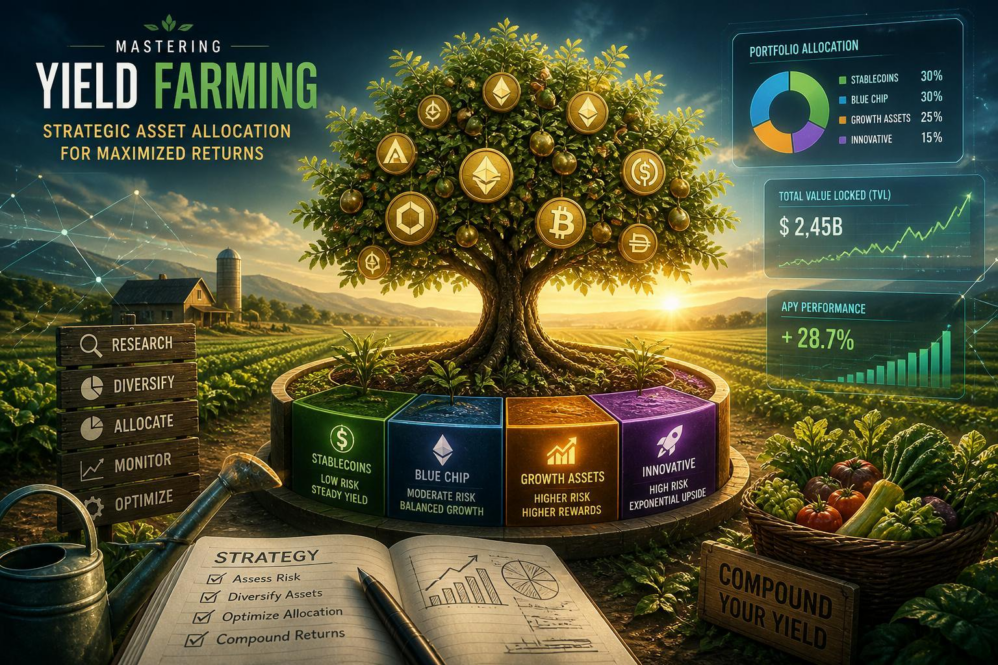
Strategic asset allocation is a cornerstone of yield farming, aiming to maximize returns while minimizing risks.A well-structured portfolio balances high-potential assets with safer investments, creating a diverse ecosystem that cushions against volatility. Key to this approach is understanding the varied yields available in the market, from stocks to bonds and real estate, each with its unique risk-reward profile. As an example, while stocks might offer higher returns through capital thankfulness and dividends, bonds provide a steady income stream with lower risk.
One effective method to minimize risks is by diversifying across different asset classes. This strategy spreads your investment across various sectors, thereby reducing the impact of poor-performing assets on your overall portfolio.It is indeed also crucial to keep an eye on market trends and adjust your portfolio accordingly. Periodic rebalancing can definitely help in maintaining your desired level of risk and return. This involves regularly reviewing your investments and making adjustments to align with your financial goals and risk tolerance.
- High-Risk, High-reward:
- Includes speculative stocks, cryptocurrency investments, etc.
- Moderate-Risk, Balanced:
- Typically involves a mix of equities and fixed-income securities.
- Low-Risk, Conservative:
- Comprises mainly fixed-income instruments like bonds and money market funds.
It is essential to evaluate the historical performance of assets and the economic conditions that may affect future returns. Understanding the yield to maturity of bonds, for instance, can provide insights into the total return an investor expects to earn by holding a bond until it matures. This knowledge helps in making informed decisions about the mix of short-term and long-term bonds in your asset allocation. The yield to worst table provides an additional layer of protection by estimating the lowest possible yield that could be realized on a bond, considering various redemption features.
| Bond Type | Yield to Maturity | Yield to Worst | Current Yield |
|---|---|---|---|
| government Bonds | 3.5% | 3.2% | 3.3% |
| Corporate Bonds | 4.0% | 3.8% | 4.1% |
Minimizing risks also includes staying informed about regulatory changes and emerging trends in the financial markets. This proactive approach enables investors to seize opportunities while sidestepping potential pitfalls. being vigilant about shifts in market conditions can signal the need for adjustments to your portfolio. Such as, during economic downturns, shifting towards more stable assets can protect capital. By adopting these strategies, investors can navigate the complexities of yield farming and position themselves for sustainable growth.
Implementing Advanced Techniques for Enhanced Earnings
When discussing advanced techniques for yield farming, the concept of yield in finance represents the earnings generated by your investments, measured as a percentage of your initial investment amount. This return can come from various sources, such as dividends, interestand capital appreciation.To maximize returns, investors must carefully consider how to allocate their assets among different investment types. Yield farming involves deploying strategies such as staking, liquidity miningand governance token incentives, to optimize these returns.
Understanding and applying the concept of yield, as defined by yield in finance, demands that you remain vigilant about market trends and opportunities. This entails closely watching the performance of the assets in your portfolio to identify where additional gains might be realized. One critical aspect of yield farming is allocating assets across diverse platforms and tokens to benefit from different reward structures and to minimize risk. As a notable example, staking tokens on various decentralized finance (DeFi) applications can provide a steady stream of income.
To effectively implement yield farming strategies, it’s crucial to monitor and adjust your portfolio regularly. This practice allows you to take advantage of short-term opportunities and avoid prolonged periods of low returns. As the financial dictionary explains, the term ‘yield’ in finance encapsulates the earnings you receive from your investment, illustrating the importance of keeping your assets dynamic and responsive to changing market conditions. The key is to strike a balance between risk and reward, aiming for a mix that suits your investment goals.
| Strategy | Risk Level | Potential Return |
|---|---|---|
| Liquidity Mining | Moderate | High |
| Staking | Low | Moderate |
| Governance Token Incentives | High | Very High |
An effective yield farming approach involves not only diversifying your assets and engaging with various platforms but also considering the use of advanced tools like automated market makers (AMMs) and other DeFi protocols designed to enhance earnings through strategic interactions. By deploying your assets thoughtfully, you can increase your yield and bolster your overall financial position in the DeFi ecosystem.
Staying Informed with market Trends and Insights
Effective yield farming requires a deep understanding of the financial landscape, including the five essential types of yield: stock yield, bond yield, maturity yield, yield to worstand yield to call. Each type serves a different purpose and is suited to specific market conditions. As a notable example, understanding bond yields not only involves calculating the current return based on the bond’s price and coupon payments but also considering the potential for reinvestment or redemption. This nuanced approach is crucial for maximizing your returns in the long term.
Investors must track and analyze market data meticulously to make informed decisions. A prosperous yield farming strategy involves closely monitoring interest rates, market trends, and economic indicators. Keeping abreast of these factors enables investors to anticipate shifts and adjust their portfolios accordingly. Such as,a rising interest rate environment might necessitate a shift towards shorter-term bonds,while a period of economic downturn could be an opportune time to explore stocks with high dividend yields. This dynamic approach is key to optimizing asset allocation and maximizing returns.
To better understand the diverse range of yields, consider the following table, which outlines the core differences between the five types of yields discussed. This information can serve as a handy reference and guide when making investment decisions.
| Type of Yield | Description |
|---|---|
| Stock Yield | The percentage return of a stock based on its dividends and the current price. |
| Bond Yield | The current yield generated by a bond based on its price. |
| Maturity Yield | The yield earned when a bond reaches its maturity value. |
| Yield to Worst | The lowest potential yield an investor might receive if a callable bond is held until the call date. |
| Yield to Call | The yield an investor might earn if a bond is called before its maturity, assuming the bond is called on the earliest possible date. |
staying informed does not mean simply reacting to what the market does; it involves proactive engagement and a deep understanding of the principles behind these yields.This knowledge empowers investors to predict market movements and craft strategies that capitalize on opportunities and mitigate risks. With a robust grasp of yield calculations and market trends, savvy investors can navigate the complexities of the financial world and achieve their return objectives.


